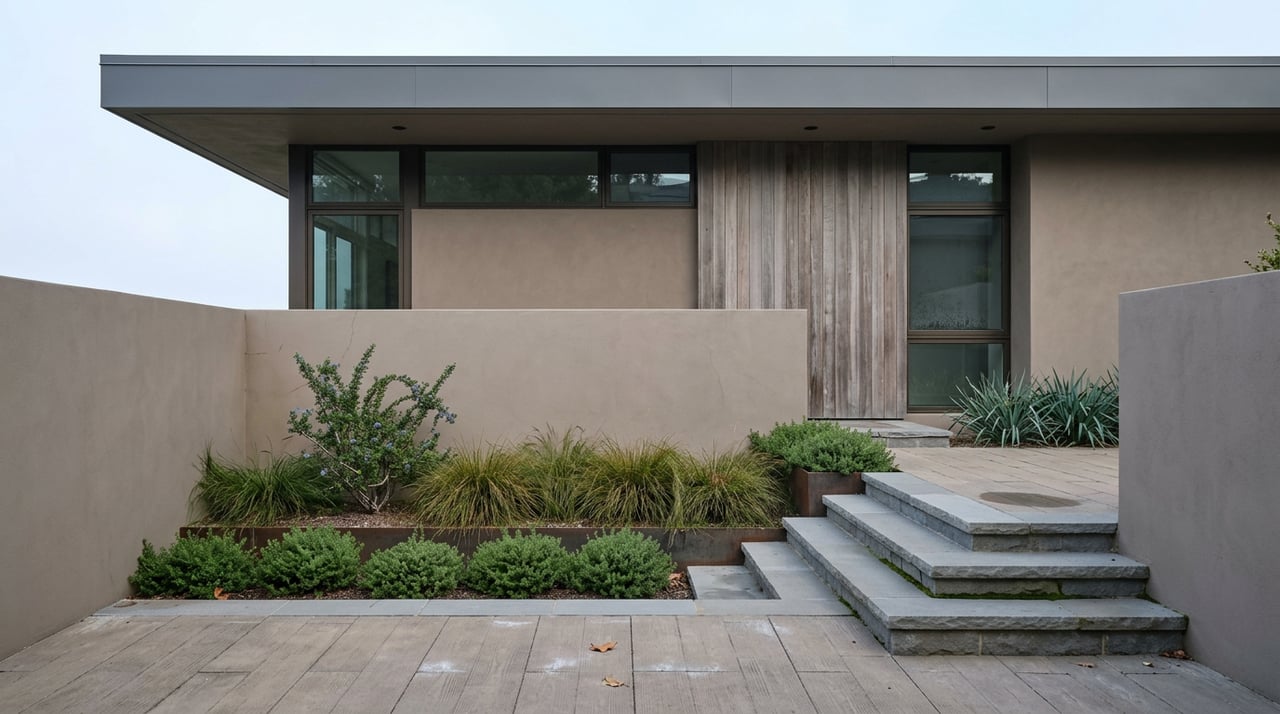
Potrero Hill's Ten-Year Staircase Finally Gets Built. Here's Who Actually Built It.
September 17, 2026
September 17, 2026
Walk to the end of 22nd Street where it meets Missouri, on the Dogpatch side, and you will find a chain-link fence, a pile of dirt, and a path that has led nowhere for the better part of a decade. Residents on both sides of the hill know this spot. It shows up in neighborhood meeting minutes, in city permit files, in a decade of frustrated emails to a developer who eventually stopped answering them. This year, for the first time since anyone started keeping track, that stretch of hillside is finally getting a real staircase. The story of why it took ten years, and who ultimately paid for it, tells you more about how this neighborhood actually functions than any list of new restaurants ever could.
The staircase was supposed to connect Dogpatch to the crest of Potrero Hill in one continuous run, from the 22nd Street Caltrain station up past the Recreation Center to the shops on 18th Street. It was never meant to be complicated. Back in 2015, during the height of the Eastern Neighborhoods rezoning boom that took Dogpatch from roughly 800 housing units to nearly 5,000, a developer called Align agreed to build the lower segment as a public benefit tied to The Landing, its 256-unit apartment complex at 1395 22nd Street. The building opened in 2019. The stairs did not follow.
What residents got instead was a stub: a partial run of steps between 22nd and Texas streets that stops abruptly, dead-ending in dirt. Katherine Doumani, a member of the Dogpatch Neighborhood Association, has called it a "staircase to nowhere." Jennifer Serwer, who leads the volunteer group Friends of Potrero Hill Recreation Center, put it more bluntly to the San Francisco Chronicle earlier this year: "They just ghosted everybody." Align, for its part, had spent years pursuing permits, but from the neighborhood's vantage point, a legally required amenity had simply stalled out.
So the neighborhood stopped waiting on it.
While the lower segment sat unfinished, a separate stretch of the same route, between Missouri and Connecticut streets on the upper hill, became the project of Friends of Potrero Hill Recreation Center. Nobody owed this segment to anyone. There was no development agreement forcing it into existence. It existed only because a handful of named neighbors decided the dirt path connecting the park to the Potrero Annex housing complex and the rest of Dogpatch was unsafe and worth fixing themselves.
They spent almost a decade assembling the money one grant and one donation at a time. The funding stack, as documented by the Dogpatch and Northwest Potrero Hill Green Benefit District, looks like this:
By late 2025, the group had its plans approved by Rec and Park and was clearing final city permitting, with construction penciled in for winter 2025 into 2026. Potrero View, the neighborhood's own newspaper, reported that Lanier Construction has since begun the work, replacing the steep dirt trail on the park's north edge with a proper box-step stair. It is a smaller, plainer stretch of stairs than the polished concrete run Align once promised. It is also, this year, the one actually rising out of the hillside.
That contrast, a developer's obligation stalling while a volunteer group's unfunded ambition gets built, is not an isolated story on this hill. It is closer to how the neighborhood's most durable institutions have always worked.
Consider the timing. Last November, the 26th annual Potrero Hill and Dogpatch History Night drew more than 350 people to Pier 70's Building 12, its largest crowd yet, to hear Philip DeAndrade tell the story of Goat Hill Pizza, the restaurant his family has run on the hill for decades, and to hear Edward Hatter recount the history of the Potrero Hill Neighborhood House, the Julia Morgan-designed settlement house that has anchored the community for over a century. Eight days later, Goat Hill Pizza itself turned fifty, a run that started with five friends, Joel and Loris Lipski, Karen Clark, Ruthann Dickinson, and DeAndrade, and never depended on outside capital to keep going.
None of these institutions are new. All of them are, in their own way, still expanding. The Neighborhood House is the same organization that co-organizes the Potrero Hill Festival, which returns to 20th Street on October 17 for its 51st year, benefiting Daniel Webster and Starr King elementary schools and the Neighborhood House's own youth programs. Fifty-one years is longer than most San Francisco businesses last, let alone volunteer-run civic institutions. The staircase project fits the same mold: a small group of residents outlasting a decade of bureaucratic and developer delay because they were never going to be the ones to give up on it.
Even the smaller, quieter fixtures on the hill trace this pattern. Christopher's Books still occupies the same Victorian storefront on 18th Street that housed a neighborhood pharmacy called Wilsons a hundred years ago. The building changed hands and purposes, but something has occupied that ground floor, serving this same stretch of sidewalk, for a century straight.
If you want to see this durability in motion rather than read about it, mark October 17. The 51st annual Potrero Hill Festival spans four blocks of 20th Street between Wisconsin and Missouri, from 10 a.m. to 4 p.m., with two stages of live music, more than a hundred food and craft vendors, and proceeds going to the same public schools and Neighborhood House that have anchored the hill for generations.
Walk that stretch of 20th Street that day and you are standing two blocks from where the new staircase segment is going in. The same neighborhood organizing a fifty-first festival is, in effect, the same civic muscle that spent ten years and roughly $560,000 in patched-together grants and donations getting a public safety fix built that a private developer never delivered.
The lesson here is not that developers cannot be trusted to finish what they promise. Align's permitting delays were real and documented, not a simple matter of bad faith. The lesson is narrower and more useful if you live here: on this hill, the things that get built reliably are the things a named group of residents refuses to let drop, funded in small pieces over years, rather than the things written into a single approval document and left to one company's timeline. That is true of a staircase. It has also been true, for half a century, of a pizzeria, a settlement house, and a street festival that keeps adding candles.
If you are watching this neighborhood's rhythms closely enough to care why a dirt path finally got fixed, you already understand something about Potrero Hill and Dogpatch that a listing sheet never will. When the time comes to think about property here, or in any of San Francisco's neighborhoods with this kind of layered civic history, Stephen J Bartlett brings that same attention to detail to the market itself. Schedule a market consultation when you're ready to talk specifics.
Stay up to date on the latest real estate trends.
Along with his team, Stephen believes that you are entitled to the best real estate counsel you can get. Personal. Engaged. Strategic. Effective.